10 Best Mindshow Alternatives for Better AI Slides Generation
Mindshow is one of the many AI presentation tools people try when they want to make slides faster. Like other tools in this category, it helps users turn ideas into presentations without starting from a blank page every time. That can save time, especially when you need a first draft quickly.
But speed alone is not enough for most real presentation work.
A lot of users do not just need slides. They need clear structure, clean flow, strong business logic, better exports, and less editing after generation. That is where many AI presentation makers still fall short. A deck may look fine at first, but once you open it for a real meeting, you realize the narrative is weak, the layout needs work, or the output still feels like a draft.
That is why many users start looking for Mindshow alternatives.
Some want a tool that works better for business decks. Some want something easier to use with PowerPoint or Google Slides. Others care more about visual polish, document-to-slide workflows, or fast conversion from notes, PDFs, or web content.
In this guide, we will look at the 10 best Mindshow alternatives for users who want faster, cleaner, and more practical AI presentation workflows.
Why look for a Mindshow alternative?
The main reason is simple: most presentation users are not only looking for AI generation. They are looking for less cleanup.
That sounds small, but it is actually the biggest difference between tools.
Many AI slide makers are good at producing a draft quickly. Fewer are good at producing a draft that already feels usable. In real work settings, the first version matters less than how much time you still need to spend fixing it.
Users usually start looking for alternatives when they run into one or more of these problems:
- the structure feels weak
- the deck looks nice but is not meeting-ready
- the output is too generic
- exporting is messy
- editing feels limited
- the workflow does not match how they already work
- the tool is good for idea generation but weak for practical presentations
That is why choosing the right alternative depends less on “which tool has AI” and more on what kind of presentations you actually make.
What makes a good Mindshow alternative?
A strong Mindshow alternative should do at least one of these things better:
- create better first drafts
- produce clearer business structure
- support PowerPoint-style presentation logic
- offer easier editing and export
- turn existing files into slides faster
- help users make decks with less manual cleanup
Different tools are better for different needs. Some are built for modern visual storytelling. Some are better for design automation. Some are better for classroom slides or quick sharing. Others are better for actual work decks like reports, client presentations, and strategy reviews.
That is the lens we will use in this list.
1. Dokie AI — Best Overall Mindshow Alternative
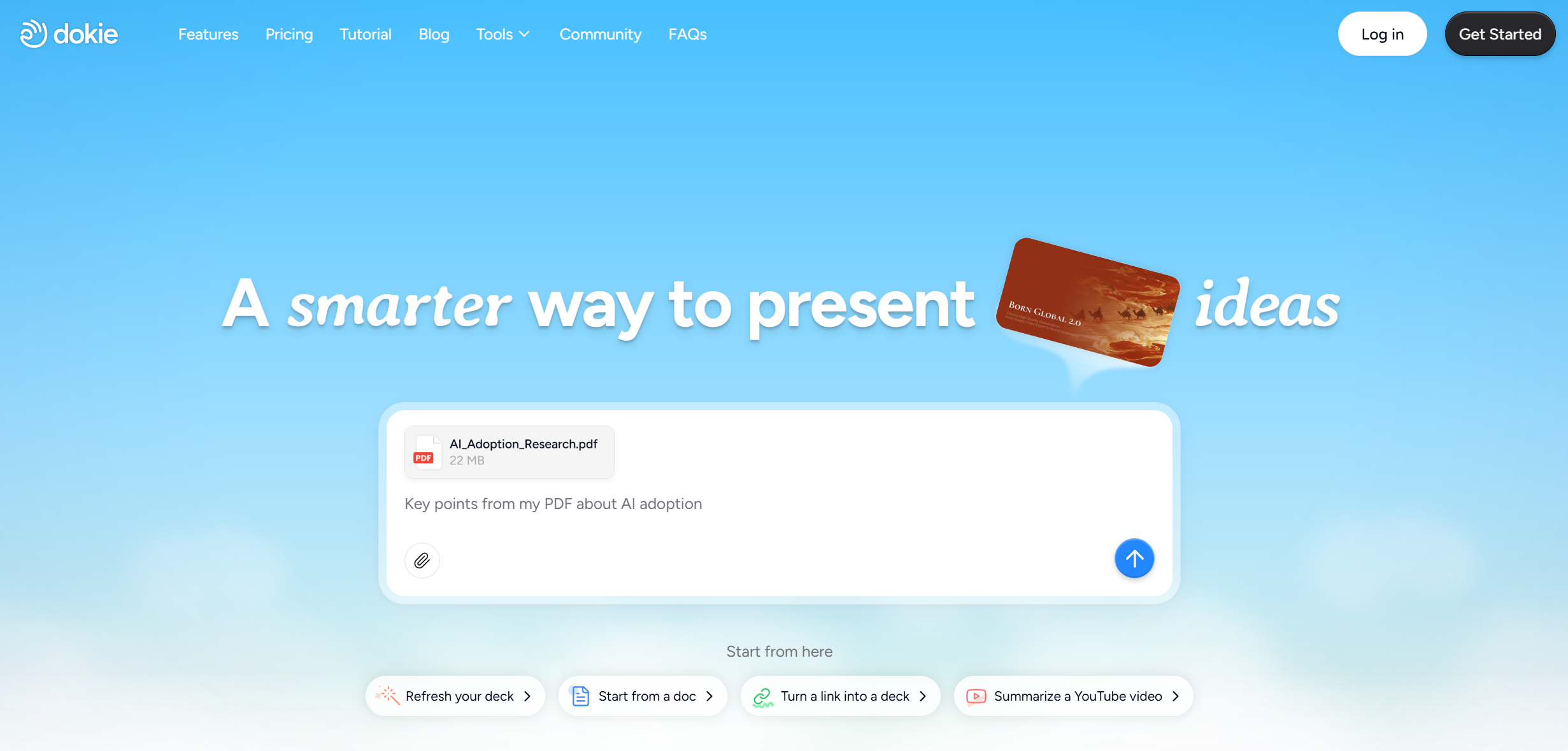
Dokie AI is the best Mindshow alternative for users who create business presentations, internal reports, strategy decks, weekly updates, and client-facing slides.
What makes Dokie AI stand out is that it focuses more on presentation usefulness than on just fast generation. Many AI slide tools are good at producing something quickly, but the result still feels like a rough draft. You still need to reorganize sections, adjust the message flow, rewrite summaries, and rebuild key slides before the deck is actually usable.
Dokie AI is stronger because the output tends to feel more like a real working presentation from the start.
That is especially important for users who make presentations often. If you are building weekly reports, monthly summaries, business reviews, pitch decks, or team updates, the biggest time cost is usually not creating slides from zero. It is fixing the structure after the AI is done. Dokie AI reduces more of that friction than many alternatives.
Another major advantage is that Dokie AI is not limited to prompt-based generation. It also offers a wide range of free AI PPT tools, including:
That gives it a much broader workflow advantage. A lot of presentation work starts with source material that already exists. You may already have a PDF, a document, a spreadsheet, a written outline, or a web page. In those cases, a tool that can convert existing material into slides is much more useful than one that only starts from a blank prompt.
Dokie AI is also a better fit for users who still want something that feels close to a traditional PPT workflow. It is not trying to turn every deck into a flashy web page. It is better when you want something practical, editable, and closer to how business users already think about presentations.
Pros
- Stronger business-ready deck structure
- Better for reports, updates, and work presentations
- Useful free file-to-PPT conversion tools
- Practical output for real presentation scenarios
- Good fit for traditional PPT-style workflows
Cons
- Final visual polish may still need light editing
- Less focused on flashy effects than some web-first tools
Best for
Professionals who care more about usable presentation structure than novelty.
2. Gamma — Best for Modern, Web-Style Presentations
Gamma is one of the best-known AI presentation tools in the market, and for good reason. It is fast, visually polished, and easy to share. Compared with Mindshow, Gamma often feels more modern and more presentation-native in its product experience.
Its biggest strength is that it does not really feel like classic slide software. It feels more like a hybrid between a presentation builder, document tool, and web page creator. That makes it very attractive for users who want sleek output and easy link sharing.
Gamma is especially strong when you need:
- quick first drafts
- visually modern layouts
- easy online sharing
- less dependence on classic slide design habits
That said, Gamma is not always the best choice for users who mainly create formal business decks. Sometimes the output feels more like a visual narrative document than a presentation meant for a traditional meeting. That can be a plus or a minus depending on your use case.
Pros
- Modern and polished output
- Very fast for idea-to-deck workflows
- Great for web-style presentations and link sharing
- Strong for visually driven storytelling
Cons
- Less traditional PPT feel
- Some business decks may still need reworking
- Not always ideal for classic executive or client review formats
Best for
Users who want a sleek, modern presentation experience.
3. Plus AI — Best for Google Slides and PowerPoint Users
Plus AI is one of the strongest Mindshow alternatives for people who already spend most of their time inside Google Slides or PowerPoint. Instead of asking users to completely change their workflow, it fits into tools they already know.
This matters more than it sounds.
For many teams, the best AI presentation tool is not the one with the fanciest generation. It is the one people will actually use. Workflow compatibility is a huge part of that. If a tool can help inside your existing stack, adoption is much easier.
Plus AI is a strong choice for:
- teams already using Google Slides heavily
- users who want AI support without changing tools
- companies that need lower friction adoption
- presentation creators who prefer familiar editing environments
It may not feel as distinct as tools built around a full new creation experience, but that is also part of its value. It is practical.
Pros
- Strong workflow fit for Slides and PowerPoint users
- Easier team adoption
- Lower learning curve
- Good for users who want AI inside familiar tools
Cons
- Less differentiated if you want a brand-new creation experience
- Output may still need narrative cleanup
- More workflow-driven than format-redefining
Best for
Users who want AI support inside existing presentation tools.
4. Beautiful.ai — Best for Design Automation
Beautiful.ai remains one of the strongest options for users who care a lot about how slides look. If your biggest pain point is layout, spacing, and visual consistency, it is still one of the most recognizable tools in the category.
Compared with Mindshow, Beautiful.ai usually feels more design-focused and more formatting-aware. It is useful for people who want visually cleaner decks without spending a lot of time adjusting every slide by hand.
Its core value is simple: it helps people make slides look better faster.
However, there is an important tradeoff. Design automation is not the same thing as business logic. A deck can look polished and still feel weak in structure. That is why Beautiful.ai is excellent for some users, but not always the best option for heavy strategy or report-style workflows.
Pros
- Strong visual polish
- Cleaner layouts with less manual work
- Helpful for users who care about presentation aesthetics
- Good for fast design improvement
Cons
- Can feel restrictive for highly custom decks
- Less strong on deep presentation logic
- Not always the best for business-heavy storytelling
Best for
Users who care most about visual consistency and slide design.
5. Presentations.AI — Best for Broad AI Deck Creation
Presentations.AI is a good option for users who want a broader AI presentation platform rather than a narrow slide generator. It is often positioned as a more full-featured AI presentation maker, which makes it appealing to users exploring several presentation use cases.
Compared with Mindshow, it may feel more platform-like and more feature-rich. That can be a plus for users who want flexibility across different presentation types, from business content to more general-purpose decks.
It is especially worth testing if you want:
- a wider set of AI presentation features
- support for multiple types of deck creation
- a more feature-complete AI deck builder
The tradeoff is that broader platforms are not always the strongest in one specific area. Users making serious business decks may still need to review structure and clarity carefully.
Pros
- Broad AI presentation use cases
- Useful for different types of decks
- More feature-rich than simpler tools
- Good for users exploring options
Cons
- Output quality can vary by use case
- May still require structural cleanup
- Can feel less focused than specialized tools
Best for
Users who want a more flexible AI deck-building platform.
6. AutoPPT — Best for Fast PPT Drafts
AutoPPT is a strong option for users who want quick, straightforward AI presentation creation without too many extra layers. It is not trying to redefine the category. Its value is in speed and simplicity.
Compared with Mindshow, AutoPPT can feel more direct. That makes it useful when your main goal is to get a deck started quickly and then refine it yourself.
It is a practical choice for:
- quick draft generation
- lightweight productivity workflows
- users who want minimal friction
- presentation creators who value speed over advanced refinement
It is not the best tool for deep business storytelling, but that is not really the point. It is for getting from blank page to editable deck fast.
Pros
- Fast and simple workflow
- Good for quick PPT creation
- Easy to try and easy to use
- Minimal friction for first drafts
Cons
- Less differentiated for complex business needs
- Output may still feel generic
- Often requires manual refinement afterward
Best for
Users who want quick AI-generated presentation drafts.
7. SlidesGPT — Best for Outline-to-Slides Workflows
SlidesGPT is a useful alternative for people who want to go from a topic, prompt, or outline to a presentation quickly. It is best understood as a fast drafting tool rather than a full presentation solution.
Compared with Mindshow, SlidesGPT is attractive for users who care more about speed than polish. It works well when you want a starting point, not a finished deck.
That makes it especially useful for:
- brainstorming presentation directions
- fast outline generation
- rough draft building
- low-stakes presentations
For more serious use cases, users will usually need to spend time improving message flow, slide quality, and final structure.
Pros
- Fast topic-to-slides workflow
- Good for rough first drafts
- Simple and easy to use
- Helpful for fast ideation
Cons
- Output can feel generic
- Often needs cleanup for professional use
- Not always strong in structure or polish
Best for
Users who want to turn ideas into rough slide drafts quickly.
8. Smallppt — Best for Lightweight AI Presentation Needs
Smallppt is a reasonable choice for users who want a lighter AI presentation workflow. It is not trying to be the most advanced platform in the category. Instead, it is more useful for users with simpler presentation needs.
Compared with Mindshow, Smallppt may appeal to users who want:
- a lighter workflow
- basic AI deck support
- low complexity
- fast testing across simple use cases
It is better for lightweight slide creation than for high-stakes presentations. That is important to keep in mind. If you are creating team reports, executive decks, or client-facing materials, you may outgrow it quickly.
Pros
- Simple workflow
- Good for lightweight use cases
- Easy for basic deck generation
- Lower complexity than some larger tools
Cons
- Less powerful for advanced decks
- Limited for complex business presentations
- May not be strong enough for important presentations
Best for
Users with basic or lightweight presentation needs.
9. EasySlides — Best for Simplicity and Accessibility
EasySlides is a good option for users who want something approachable. Some AI presentation tools try to do too much too early. EasySlides is more attractive to people who want a simple experience without a big learning curve.
Compared with Mindshow, its value is mainly in ease of use. It is a tool you can test quickly and understand quickly, which matters for casual users and first-time AI presentation users.
It is a better fit for:
- beginners
- casual presentation makers
- people who want a clean starting point
- users who value ease over depth
It will not be the strongest option for more demanding business workflows, but it works as a low-friction entry point.
Pros
- Beginner-friendly
- Easy to learn
- Simple presentation flow
- Low barrier to entry
Cons
- Less depth for advanced users
- Not ideal for complex decks
- May require switching tools as needs grow
Best for
Users who want an easy and simple AI presentation experience.
10. Wonderslide — Best for Visual Upgrades
Wonderslide is useful for users who already have content and want to make it look better. That makes it slightly different from tools focused mainly on generation.
Compared with Mindshow, Wonderslide is often more relevant when your problem is not “I need a presentation,” but “I need these slides to look cleaner.” That is a real and common use case.
It is especially useful for:
- visual cleanup
- slide redesign
- improving rough decks
- making existing slides more polished
Its limitation is that visual improvement is only one part of presentation quality. If the structure is weak, better visuals alone will not solve the whole problem.
Pros
- Good for visual improvement workflows
- Useful for upgrading existing slides
- Helpful when content already exists
- Better for slide makeover tasks
Cons
- Less focused on deep structure creation
- Not the best for full deck generation from scratch
- Does not solve every presentation problem
Best for
Users who want to improve the look of existing slides.
Which Mindshow alternative is best?
The best Mindshow alternative depends on what kind of work you do.
If you mainly create:
- business decks
- weekly reports
- internal reviews
- client presentations
- strategic updates
then Dokie AI is the strongest choice because it focuses more on making presentations that already feel usable in real work settings.
If you care more about:
- modern visual storytelling, choose Gamma
- working inside Google Slides or PowerPoint, choose Plus AI
- automatic design help, choose Beautiful.ai
- quick first drafts, choose AutoPPT or SlidesGPT
- improving existing slide design, choose Wonderslide
The right answer depends less on which tool is the most famous and more on which tool reduces the most work after generation.
Final Verdict
Mindshow can be a useful starting point if you want AI help with presentation creation. But for many users, it will not be the best long-term fit. As presentation workflows become more practical and more frequent, users usually need better structure, cleaner editing, stronger exports, and more flexible ways to turn source content into slides.
For most professional users, Dokie AI is the best Mindshow alternative because it is built more around usable business presentations, not just fast output. It is especially strong for people who make real work decks and want to spend less time reorganizing what the AI already created.
If your goal is not just to generate slides, but to generate slides you can actually use, Dokie AI is the strongest option in this list.
FAQs
1. What is the best Mindshow alternative for business presentations?
Dokie AI is one of the best Mindshow alternatives for business presentations because it focuses on clearer deck structure, work-ready slide flow, and also provides multiple free file-to-PPT tools.
2. Which Mindshow alternative is best for modern presentations?
Gamma is one of the strongest options for users who prefer modern, web-style presentations with sleek layouts and easy sharing.
3. Which Mindshow alternative works best with Google Slides or PowerPoint?
Plus AI is a strong fit for users who already work heavily inside Google Slides or PowerPoint and want AI support inside familiar tools.
4. Which Mindshow alternative is best for slide design?
Beautiful.ai is a good choice if your top priority is cleaner layouts, better spacing, and stronger visual consistency.
5. Are AI presentation makers good for business decks?
Some are, but not all. Many AI presentation tools are fast at generating drafts, but fewer are good at producing presentations with clear business logic and usable structure. That is why tool choice matters.