12 Methods of Market Research: A Simple Guide for Better Business Decisions
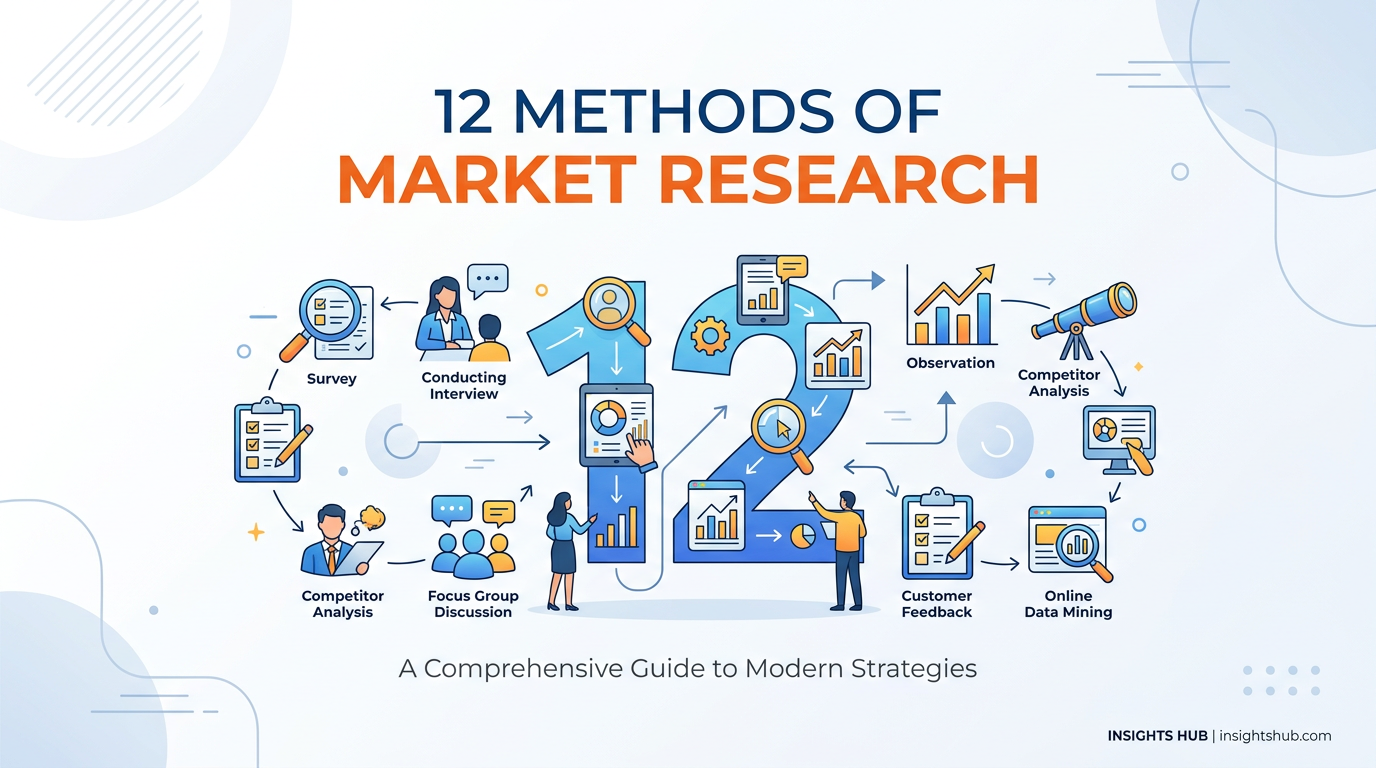
Market research helps you make smarter business decisions. Instead of guessing what customers want, you collect information from real people, market data, competitors, and product behavior.
You can use market research before launching a product, improving a service, entering a new market, changing prices, or planning a marketing campaign. Below are 12 useful methods of market research, with simple examples of when to use each one.
What Is Market Research?
Market research is the process of collecting and analyzing information about a market. It helps you understand your target customers, their needs, buying behavior, problems, and expectations.
It can also help you study competitors, market size, pricing, trends, and product demand. Good market research reduces risk because it gives your team better evidence before making decisions.
Primary vs. Secondary Market Research
Market research usually falls into two types: primary research and secondary research.
Primary research means you collect new information directly from people. Examples include surveys, interviews, focus groups, and product tests.
Secondary research means you use information that already exists. Examples include industry reports, public data, competitor websites, online reviews, and search data.
Both types are useful. Primary research gives you direct feedback, while secondary research helps you understand the bigger market faster.
1. Surveys
Surveys are one of the most common market research methods. You ask a group of people the same questions and collect their answers.
Surveys are useful when you want to understand customer preferences, buying intent, pricing opinions, product needs, or satisfaction levels. They work well because you can collect many responses quickly.
For example, if you are building a new AI presentation tool, you can ask users what they struggle with most when making slides. The answers may show whether users care more about design, structure, speed, templates, or export quality.
Good survey questions should be short, clear, and easy to answer. Avoid asking too many questions at once. A survey with 5 to 10 strong questions is often better than a long survey that people do not finish.
2. Customer Interviews
Customer interviews help you understand people more deeply. Instead of only collecting short answers, you talk to customers and ask follow-up questions.
This method is useful when you want to understand why people make certain decisions. Surveys can tell you what people choose, but interviews can explain why they choose it.
For example, a customer may say they need a presentation maker. During an interview, you may learn that their real problem is not slide design. Their bigger problem is turning messy notes into a clear business story.
Customer interviews are especially helpful for new products, positioning, pricing, and product improvement. They can reveal problems that users may not mention in a simple survey.
3. Focus Groups
A focus group is a small group discussion with people from your target market. A moderator asks questions, and participants share their opinions.
Focus groups are useful when you want to test ideas, messages, product concepts, or brand positioning. You can see how people react in real time and how their opinions change during discussion.
For example, you can show different landing page headlines to a group of business users and ask which one feels more useful. Their reactions may help you decide whether to focus on “beautiful slides,” “business-ready presentations,” or “faster reporting.”
The downside is that one strong personality can influence the group. For this reason, focus groups should not be your only research method. They are best used together with surveys, interviews, or product data.
4. Competitor Analysis
Competitor analysis helps you understand what other companies are doing in your market. You can study their products, pricing, positioning, traffic channels, content, ads, reviews, and customer complaints.
This method is useful when you want to find gaps in the market. If many competitors offer similar features, you need to understand how your product can stand out.
For example, if you are researching AI presentation tools, you can compare how competitors describe their products. Some may focus on design, some on speed, and some on AI generation. You can also read reviews to see what users like or dislike.
Competitor analysis should not mean copying competitors. The goal is to learn the market, find opportunities, and build a stronger position.
5. Customer Review Analysis
Customer reviews are a powerful source of market research. Reviews show what real users like, dislike, expect, and complain about.
You can study reviews from platforms like G2, Trustpilot, Capterra, app stores, Reddit, YouTube comments, and social media. Look for repeated patterns instead of focusing on one single comment.
For example, if users often complain that a tool creates good-looking slides but weak content structure, that is a clear market signal. It means users may want a tool that helps with both slide design and business logic.
Customer review analysis is useful because people often speak more honestly in reviews than in formal surveys. It can help you improve product features, messaging, support, and onboarding.
6. Social Listening
Social listening means tracking what people say online about a topic, product, brand, or competitor. This can include posts, comments, discussions, hashtags, forums, and communities.
This method is useful for understanding trends, customer pain points, and real language used by your audience.
For example, if many people on Reddit are asking for faster ways to create weekly report slides, that may show a real use case. If people on LinkedIn are discussing AI tools for work productivity, that may show a content or marketing opportunity.
Social listening is also useful for finding early market signals. People may talk about new problems or new tools before they appear in formal market reports.
7. Keyword Research
Keyword research helps you understand what people search for online. It is useful for SEO, content planning, product positioning, and demand research.
If many people search for a topic, it usually means there is existing demand. Keywords can show what users want to learn, compare, buy, or solve.
For example, searches like “AI presentation maker,” “business presentation templates,” “how to make a pitch deck,” and “best PowerPoint alternatives” all show different types of intent.
Keyword research is not only for blog traffic. It can also help you understand how customers describe their problems. The words people search for may be different from the words your company uses.
8. Website and Product Analytics
Website and product analytics show what users actually do. This is different from what users say they do.
You can study traffic sources, page views, sign-up rates, conversion rates, feature usage, drop-off points, and retention. These numbers help you understand which channels, pages, and product experiences are working.
For example, if many users visit a PDF-to-PPT page but few complete the conversion, the page may have a trust issue, unclear instructions, or weak onboarding. If users generate a presentation but do not export it, the output quality or export experience may need improvement.
Analytics are useful because they show behavior at scale. However, data alone may not explain the reason behind the behavior. That is why analytics should be combined with interviews or surveys.
9. Field Research
Field research means observing customers in their real environment. This can be in an office, classroom, store, event, or online workflow.
This method helps you understand how people actually use products and complete tasks. Sometimes users do not clearly explain their problems because the problems feel normal to them.
For example, if you observe a teacher preparing class slides, you may notice that they spend more time organizing lesson structure than designing slides. If you observe a business user making a report deck, you may see that they copy content from many sources before building the final presentation.
Field research is especially useful for workflow products, office tools, education tools, and physical products. It helps you see real behavior, not just reported behavior.
10. Product Testing
Product testing means giving users a product, prototype, landing page, or feature and watching how they respond.
This method is useful before a full launch. You can test whether users understand the product, complete key actions, and see value quickly.
For example, you can ask users to create a presentation from a short prompt. Then you can observe whether they know what to do next, whether they like the first result, and whether they want to edit or export the slides.
Product testing can reveal problems in user experience, messaging, design, and feature quality. It is better to find these issues early than after spending a lot of money on marketing.
11. A/B Testing
A/B testing compares two versions of something to see which performs better. This can include landing pages, headlines, pricing pages, emails, ads, call-to-action buttons, or onboarding flows.
For example, you can test two homepage headlines:
Version A: “Create beautiful presentations with AI.”
Version B: “Turn your ideas into business-ready presentations.”
If Version B gets more sign-ups or paid users, that may show users care more about practical business output than visual design alone.
A/B testing is useful because it measures real behavior. However, you need enough traffic or responses to make the result meaningful. For small websites, A/B tests may take longer or give unclear results.
12. Market Reports and Public Data
Market reports and public data are forms of secondary research. You can use industry reports, government data, academic research, financial reports, and public databases to understand market size, growth, trends, and customer segments.
This method is useful when you need a high-level view of the market. It can help you understand whether a market is growing, which regions have demand, and what trends may affect your business.
For example, if you are entering the education technology market, reports may show growth in online learning, AI tools for teachers, or digital classroom materials. This can support your market planning.
The weakness is that reports may be too general or outdated. They should support your decisions, but they should not replace direct customer research.
How to Choose the Right Market Research Method
The best market research method depends on your goal.
If you want fast feedback from many people, use surveys.
If you want deep insights, use customer interviews.
If you want to understand competitors, use competitor analysis and review analysis.
If you want to understand demand, use keyword research and public data.
If you want to improve conversion, use website analytics and A/B testing.
If you want to improve product experience, use product testing and field research.
In many cases, the best approach is to combine several methods. For example, you can use keyword research to find demand, customer interviews to understand pain points, competitor analysis to find gaps, and product testing to improve the final experience.
Example: How a Startup Can Use Market Research
Imagine a startup wants to launch an AI tool for creating presentations. The team should not only ask, “Do people want an AI presentation maker?” That question is too broad.
A better research plan could look like this:
First, use keyword research to see what people search for. This may show demand for AI slides, pitch deck templates, and PowerPoint automation.
Second, analyze competitors to understand what products already exist and how they position themselves.
Third, read customer reviews to find common complaints. Users may say that existing tools are beautiful but hard to edit, or fast but not business-ready.
Fourth, interview target users. Business users, teachers, and students may all have different needs.
Fifth, test a prototype. Watch whether users can generate, edit, and export a deck successfully.
This process gives the startup a clearer view of the market before spending heavily on development or ads.
Use Dokie AI to Present Market Research Clearly
Market research often creates a lot of information. You may collect survey results, interview notes, competitor screenshots, customer quotes, and data charts. The hard part is turning that information into a clear story.
Dokie AI can help you turn research notes into a structured presentation. You can use it to create market research reports, competitor analysis decks, customer insight summaries, and business planning presentations.
Instead of starting from a blank slide, you can give Dokie AI your topic or outline and let it help organize the content into a business-ready deck. This is useful for teams that need to share research findings with managers, clients, investors, or internal stakeholders.
Common Mistakes in Market Research
One common mistake is only asking people what they want. Customers may not always know the best solution. It is often more useful to ask about their problems, current behavior, and decision process.
Another mistake is relying too much on competitors. Competitor research is useful, but copying competitors can make your product look the same as everyone else.
A third mistake is using only one research method. A survey may show what people say, but product analytics shows what they actually do. Interviews explain why something happens. Using multiple methods gives you a better view.
A fourth mistake is ignoring negative feedback. Complaints can be very valuable because they show unmet needs.
A final mistake is collecting research but not turning it into action. Market research should lead to decisions about product, pricing, messaging, channels, or strategy.
FAQs About Market Research Methods
1. What are the main methods of market research?
The main methods include surveys, interviews, focus groups, competitor analysis, customer review analysis, social listening, keyword research, analytics, field research, product testing, A/B testing, and market reports.
2. What is the easiest market research method?
Surveys are often the easiest method because they are fast and simple to distribute. However, interviews may give deeper insights if you need to understand customer problems more clearly.
3. What is the difference between primary and secondary research?
Primary research is information you collect directly from people, such as surveys or interviews. Secondary research uses existing information, such as reports, public data, reviews, and competitor websites.
4. Why is market research important?
Market research helps businesses reduce risk. It gives teams better information about customers, competitors, demand, pricing, and market trends before making decisions.
5. Which market research method is best for startups?
Startups should usually combine customer interviews, competitor analysis, keyword research, product testing, and website analytics. These methods are practical and can help early-stage teams make better decisions quickly.
Conclusion
Market research is not only for large companies. Any business can use it to understand customers, test ideas, study competitors, and make smarter decisions.
Start with a clear question. Then choose the research method that fits your goal. When you combine customer feedback, market data, and real product behavior, you can build better products, stronger messages, and more effective business strategies.