15 Best Skills to Put on a Resume: Examples and Tips
Your skills section is one of the most important parts of your resume. It helps employers quickly understand what you can do and whether you match the job.
But not every skill belongs on every resume. A strong resume should include skills that are relevant to the role, easy to understand, and connected to your real experience.
In this guide, we will cover the 15 best skills to put on a resume, with examples and tips to help you choose the right ones.
What Are Resume Skills?
Resume skills are the abilities you list on your resume to show what you can do.
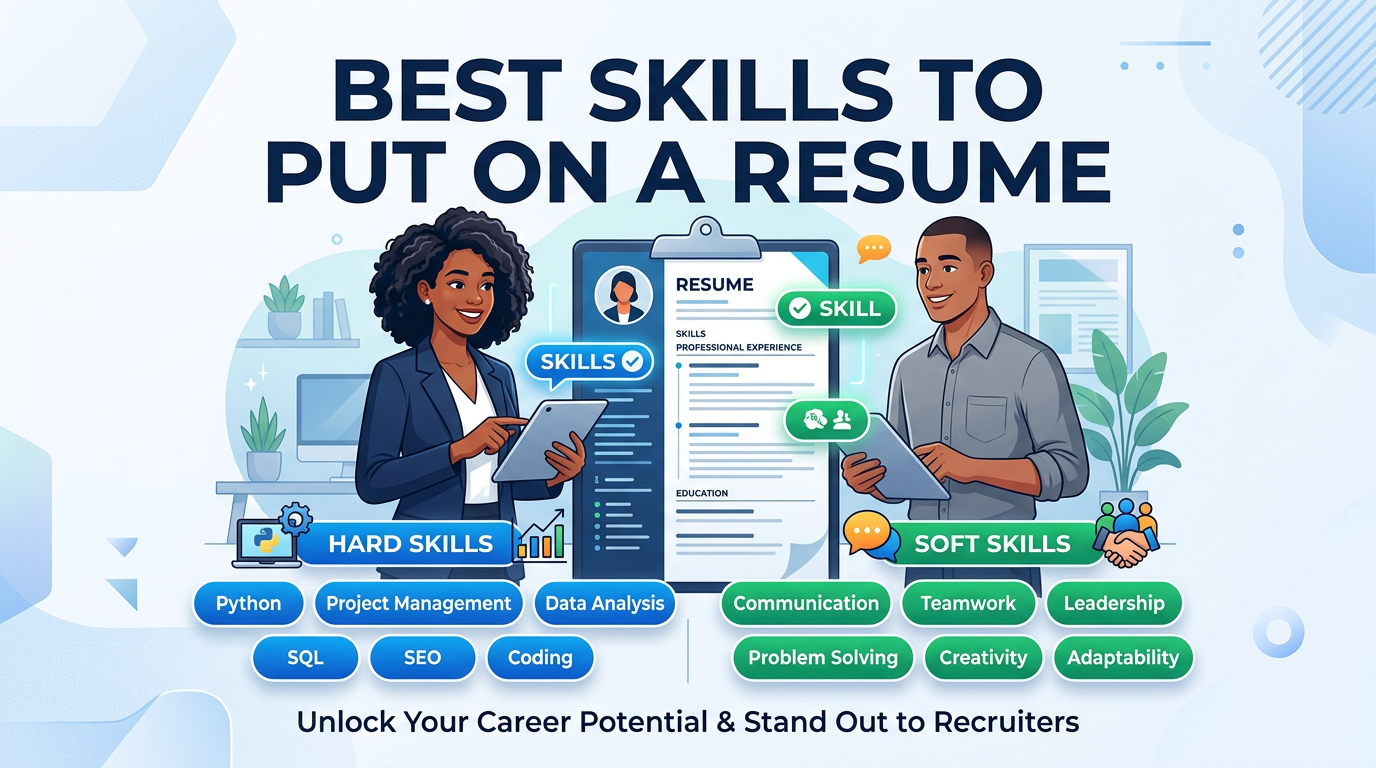
They usually fall into two main types: hard skills and soft skills.
Hard skills are specific, teachable skills. Examples include Excel, data analysis, coding, SEO, accounting, writing, design, and project management tools.
Soft skills are personal and workplace skills. Examples include communication, teamwork, leadership, problem-solving, adaptability, and time management.
A strong resume usually includes both.
Why Resume Skills Matter
Employers use resume skills to decide whether you are a good fit for a role.
Many hiring managers scan resumes quickly. If they see the right skills, they are more likely to continue reading your experience.
Resume skills also help with applicant tracking systems, or ATS. These systems scan resumes for keywords from the job description. If your resume includes relevant skills, it may have a better chance of being reviewed.
This does not mean you should stuff your resume with random keywords. The best approach is to include real skills that match the job.
1. Communication
Communication is one of the best skills to put on a resume because it matters in almost every job.
Good communication means you can share ideas clearly, listen to others, write useful messages, and explain information in a way people understand.
Resume examples:
Wrote weekly project updates for internal teams
Presented campaign results to managers and stakeholders
Communicated with customers through email, chat, and phone support
Created clear documentation for team workflows
Good for roles in marketing, sales, customer support, teaching, management, consulting, and business operations.
2. Leadership
Leadership is not only for managers. You can show leadership by guiding a project, training a teammate, organizing a group, or taking ownership of a task.
Employers like leadership skills because they show responsibility and confidence.
Resume examples:
Led a team of five students in a research presentation project
Trained new interns on content publishing workflows
Managed weekly project check-ins and task assignments
Took ownership of a product launch timeline
Good for managers, team leads, project coordinators, teachers, student leaders, and business roles.
3. Problem-Solving
Problem-solving means you can identify issues, think through options, and find practical solutions.
This is a strong resume skill because every job has problems. Employers want people who can stay calm and solve them.
Resume examples:
Identified workflow delays and created a faster reporting process
Resolved customer complaints by finding clear and fair solutions
Improved content planning after analyzing low-performing pages
Helped reduce project confusion by creating a shared task tracker
Good for operations, customer service, product, marketing, engineering, education, and management roles.
4. Teamwork
Teamwork shows that you can work well with others. This is important because most jobs require cooperation.
Strong teamwork means you can share information, respect different opinions, support group goals, and complete your part of the work.
Resume examples:
Worked with designers, writers, and managers to complete campaign assets
Collaborated with classmates to deliver a final research project
Supported cross-functional teams during product updates
Coordinated with sales and support teams to improve customer communication
Good for almost every role, especially office, education, marketing, healthcare, and customer-facing jobs.
5. Time Management
Time management means you can organize your work, meet deadlines, and focus on the right tasks.
This skill is useful for jobs with multiple responsibilities, fast deadlines, or remote work.
Resume examples:
Managed multiple content deadlines across blog, email, and social media
Completed weekly reports on schedule for three departments
Balanced coursework, internship tasks, and student club responsibilities
Prioritized urgent customer requests while maintaining response quality
Good for students, project managers, marketers, assistants, remote workers, freelancers, and operations roles.
6. Project Management
Project management means you can plan, organize, track, and complete projects.
You do not need to be a formal project manager to include this skill. If you have managed timelines, tasks, resources, or team coordination, it can be relevant.
Resume examples:
Created project timelines and tracked deliverables for marketing campaigns
Managed task assignments for a team presentation project
Coordinated product update materials across content and design teams
Used Trello to organize weekly work and monitor deadlines
Related tools:
Asana
Trello
Notion
Monday.com
Jira
ClickUp
Google Sheets
Good for operations, marketing, product, consulting, education, and business roles.
7. Data Analysis
Data analysis is a valuable skill because many companies want people who can make decisions based on numbers.
You do not need to be a data scientist. Basic data analysis can still be useful if you can read reports, find patterns, and explain insights.
Resume examples:
Analyzed campaign performance data to identify top-performing channels
Used Google Sheets to track weekly user growth and conversion rates
Reviewed customer survey results and summarized key findings
Created simple charts to explain project performance
Related tools:
Excel
Google Sheets
Google Analytics
SQL
Tableau
Looker Studio
Power BI
Good for marketing, finance, operations, product, sales, business analysis, and research roles.
8. Technical Skills
Technical skills are specific tools, platforms, or systems you know how to use.
The best technical skills depend on the job. A designer may list Figma. A marketer may list Google Analytics. A developer may list Python. An accountant may list QuickBooks.
Resume examples:
Built landing page wireframes using Figma
Used Excel formulas to clean and organize sales data
Managed customer records in Salesforce
Created basic automation workflows with Zapier
Common technical skills:
Microsoft Excel
Google Workspace
Figma
Canva
Salesforce
HubSpot
SQL
Python
WordPress
Google Analytics
QuickBooks
Good for almost every modern role, but choose tools that match the job description.
9. Writing
Writing is a strong resume skill because many jobs require clear written communication.
This includes emails, reports, articles, proposals, documentation, social media posts, and internal updates.
Resume examples:
Wrote SEO blog posts and product pages for a SaaS website
Created weekly performance reports for the marketing team
Drafted professional emails for client communication
Edited internal documents to improve clarity and consistency
Good for marketing, content, communications, teaching, customer success, operations, and admin roles.
10. Customer Service
Customer service means you can help customers, answer questions, solve problems, and create a positive experience.
Even if you are not applying for a support role, customer service can show patience, empathy, and communication ability.
Resume examples:
Responded to customer questions through email and live chat
Resolved customer complaints with clear and professional communication
Helped customers understand product features and account options
Maintained high satisfaction scores during busy support periods
Good for customer support, sales, retail, hospitality, healthcare, education, and client-facing jobs.
11. Adaptability
Adaptability means you can adjust when things change.
This is important in fast-moving companies, startups, remote teams, and roles where priorities often shift.
Resume examples:
Adapted content plans quickly based on campaign performance data
Learned new project management tools during a team workflow change
Supported changing client requests while keeping the project on schedule
Adjusted teaching materials for different student learning needs
Good for startups, marketing, product, teaching, customer support, operations, and management roles.
12. Attention to Detail
Attention to detail means you can notice errors, follow instructions, and produce accurate work.
This is useful for roles where small mistakes can create bigger problems.
Resume examples:
Reviewed reports for formatting, grammar, and data accuracy
Checked customer records to reduce duplicate entries
Edited website content before publication
Prepared error-free spreadsheets for weekly business tracking
Good for finance, admin, operations, writing, editing, legal, healthcare, and data roles.
13. Creativity
Creativity is not only for artists and designers. It also means you can generate ideas, solve problems in new ways, and improve existing work.
Resume examples:
Created new social media content ideas for product campaigns
Designed presentation layouts for classroom and business projects
Developed creative email subject lines to improve open rates
Suggested new campaign angles based on customer pain points
Good for marketing, design, content, product, teaching, social media, and business development roles.
14. Research
Research skills show that you can find information, evaluate sources, and turn details into useful insights.
This is valuable for students, analysts, marketers, writers, consultants, teachers, and business professionals.
Resume examples:
Researched competitor websites and summarized positioning differences
Collected customer feedback to identify common product issues
Prepared research notes for a market analysis presentation
Reviewed academic sources for a class research paper
Good for marketing, business analysis, education, content, consulting, product, and academic roles.
15. Presentation Skills
Presentation skills show that you can organize ideas and explain them clearly to an audience.
This skill is useful in meetings, interviews, sales calls, classroom projects, training sessions, and client presentations.
Resume examples:
Created and delivered a 10-slide market research presentation
Presented monthly campaign results to the marketing team
Built training slides for new team members
Explained project findings to classmates and instructors
Good for sales, consulting, marketing, teaching, management, business development, and student resumes.
Best Skills to Put on a Resume by Job Type
Different jobs need different skills. Here are some examples.
Marketing Resume Skills
SEO
Copywriting
Content strategy
Google Analytics
Email marketing
Social media management
Campaign reporting
Market research
Brand messaging
A/B testing
Customer Service Resume Skills
Customer communication
Problem-solving
Patience
CRM tools
Conflict resolution
Product knowledge
Email support
Live chat support
Empathy
Time management
Project Management Resume Skills
Project planning
Task tracking
Risk management
Team coordination
Stakeholder communication
Budget tracking
Timeline management
Asana
Jira
Notion
Sales Resume Skills
Negotiation
Lead generation
CRM management
Product demos
Cold outreach
Persuasion
Relationship building
Pipeline management
Objection handling
Presentation skills
Student Resume Skills
Communication
Teamwork
Research
Presentation skills
Writing
Time management
Google Docs
Google Slides
Leadership
Problem-solving
Teacher Resume Skills
Lesson planning
Classroom management
Student engagement
Presentation skills
Curriculum design
Communication
Assessment
Education technology
Creativity
Patience
How to Choose the Right Skills for Your Resume
Start with the job description. Look for the skills, tools, and responsibilities the employer mentions most.
Then compare those requirements with your real experience. Choose skills you can honestly support with examples.
For example, if a job asks for “project coordination,” your resume should mention project planning, task tracking, communication, or timeline management.
If a job asks for “content marketing,” your resume should mention writing, SEO, content planning, analytics, or campaign reporting.
The best resume skills are not random. They should connect directly to the job.
Where to Put Skills on a Resume
You can put skills in three main places.
First, add a dedicated Skills section. This helps hiring managers quickly scan your abilities.
Second, include skills inside your work experience bullet points. This is even more powerful because it shows how you used the skill.
Third, mention key skills in your resume summary if they are central to the role.
Example resume summary:
Marketing assistant with experience in SEO writing, content planning, social media management, and campaign reporting. Skilled at creating clear content and using data to improve performance.
Resume Skills Section Example
Here is a simple example:
Skills
Content writing
SEO
Google Analytics
Social media management
Email marketing
Market research
Google Sheets
Presentation design
Project coordination
Communication
This format is clean and easy to read. You can adjust it based on the job.
How to Prove Your Skills on a Resume
Listing skills is not enough. You should also prove them with examples.
Weak:
Good communication skills
Better:
Presented weekly campaign updates to managers and explained key performance changes
Weak:
Strong data analysis skills
Better:
Analyzed campaign data in Google Sheets and identified the top three traffic sources
Weak:
Good leadership skills
Better:
Led a team of four students to complete a research project and final presentation
Specific examples make your skills more believable.
Skills You Should Avoid Putting on a Resume
Avoid skills that are too basic, outdated, or unrelated.
Examples:
Microsoft Word, unless the role specifically requires document formatting
Email, unless the role requires email marketing or professional communication
Internet research, unless you can make it more specific
Hard worker
Fast learner
Friendly
Responsible
These are not always bad, but they are too general. It is better to show them through achievements.
For example, instead of “fast learner,” say:
Learned a new CRM system in two weeks and used it to manage customer records.
Use Dokie AI to Turn Resume Skills Into a Career Presentation
Your resume skills are easier to understand when you can show real examples. For interviews, portfolio reviews, or final-round presentations, you may need to explain your experience in a more visual way.
Dokie AI can help you turn your resume, work samples, and project results into a clear presentation. You can use it to create career summary slides, portfolio decks, interview presentations, and project case studies.
Instead of starting from a blank slide, Dokie AI helps organize your skills and achievements into a professional structure. This makes it easier to show your value and explain why you are a strong fit for the role.
Resume Skills Checklist
Before sending your resume, check these points:
Are your skills relevant to the job?
Did you include both hard and soft skills?
Can you prove each major skill with experience?
Did you use keywords from the job description?
Did you avoid vague skills like “hard worker”?
Are your technical tools specific?
Did you include skills in your work experience bullet points?
Is your skills section easy to scan?
Did you remove unrelated skills?
Does your resume show value, not just ability?
FAQs About Skills to Put on a Resume
1. What are the best skills to put on a resume?
The best skills to put on a resume include communication, leadership, problem-solving, teamwork, time management, project management, data analysis, technical skills, writing, customer service, adaptability, attention to detail, creativity, research, and presentation skills.
2. How many skills should I put on a resume?
Most resumes should include 6 to 12 key skills. Choose skills that are most relevant to the job instead of listing every skill you have.
3. Should I include soft skills on my resume?
Yes, but try to prove them through examples. For example, instead of only listing “leadership,” include a bullet point showing when you led a project or trained someone.
4. What are hard skills for a resume?
Hard skills are specific technical or job-related abilities, such as Excel, SQL, Google Analytics, SEO, coding, accounting, design, writing, data analysis, or project management tools.
5. What are soft skills for a resume?
Soft skills are workplace abilities such as communication, teamwork, adaptability, leadership, problem-solving, creativity, and time management.
6. Should I tailor my resume skills for each job?
Yes. You should adjust your skills section based on the job description. This helps your resume look more relevant to the role.
7. What skills should students put on a resume?
Students can include communication, teamwork, writing, research, presentation skills, time management, leadership, Google Docs, Google Slides, and project experience.
Conclusion
The best skills to put on a resume are the ones that match the job and show your real value. Do not list skills just to fill space. Choose skills that are relevant, specific, and supported by your experience.
A strong resume skills section can help employers quickly understand what you can do. When you combine the right skills with clear examples and results, your resume becomes much more convincing.