APRN vs. ARNP: What’s the Difference?
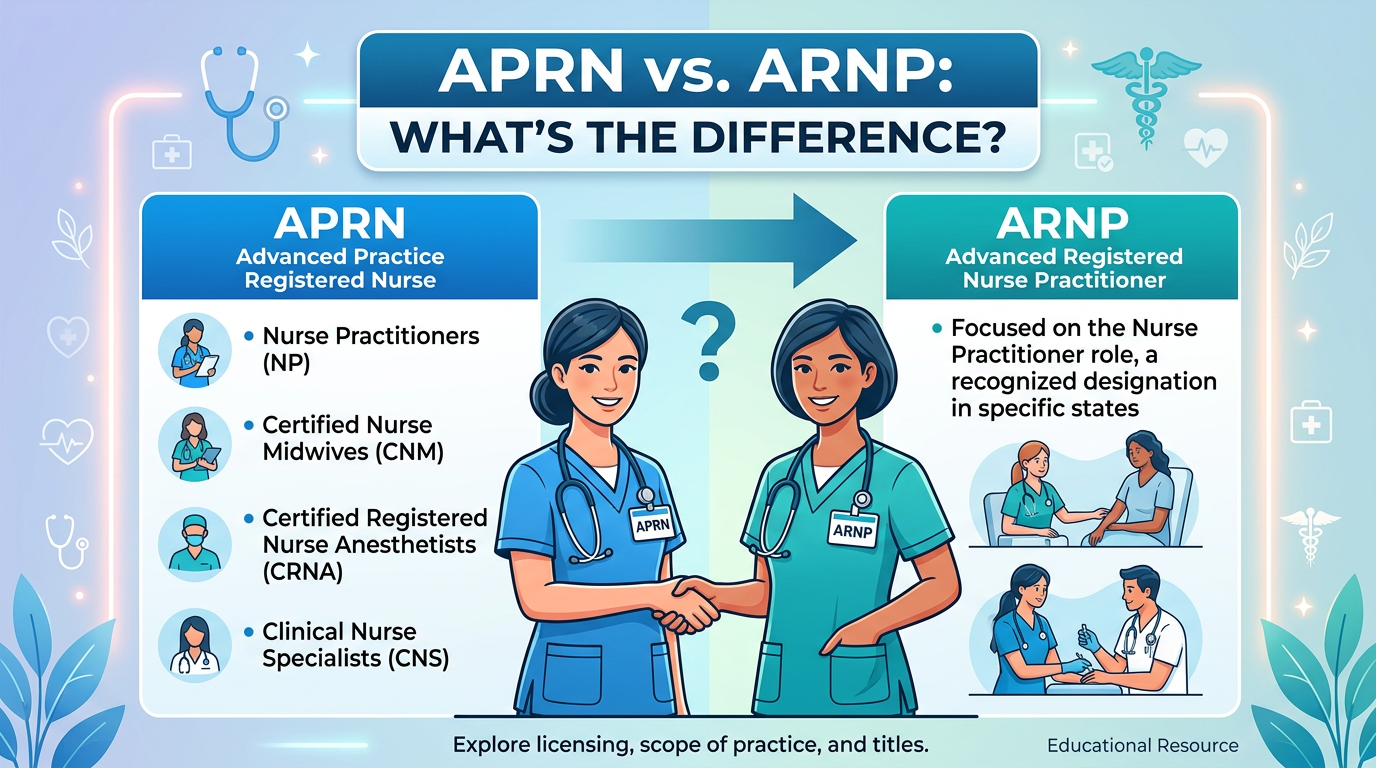
Nursing titles can be confusing. If you are researching advanced nursing careers, you may see both APRN and ARNP used online, in job posts, or on state nursing board websites.
The two terms are closely related, but they are not always used in the same way. In this guide, we will explain APRN vs. ARNP, what each title means, how they compare, and what students or job seekers should know before choosing a career path.
What Does APRN Mean?
APRN stands for Advanced Practice Registered Nurse.
An APRN is a registered nurse with advanced education, clinical training, and certification in a specific nursing role. According to the National Council of State Boards of Nursing, APRNs are educated at the master’s or post-master’s level and are prepared to assess, diagnose, manage patient problems, order tests, and prescribe medications, depending on state law.
APRN is a broad umbrella term. It can include several advanced nursing roles, such as:
Nurse Practitioner, or NP
Certified Nurse-Midwife, or CNM
Certified Registered Nurse Anesthetist, or CRNA
Clinical Nurse Specialist, or CNS
The American Nurses Association also describes APRNs as nurses who meet advanced educational and clinical practice requirements and may provide care in areas such as primary care, mental health, birthing, and anesthesia.
What Does ARNP Mean?
ARNP usually stands for Advanced Registered Nurse Practitioner.
In many places, ARNP refers specifically to a nurse practitioner. A nurse practitioner is an advanced practice nurse who can provide patient care, diagnose conditions, order tests, and manage treatment plans, depending on state rules. MedlinePlus notes that a nurse practitioner may also be called an ARNP or APRN.
However, ARNP is not used the same way everywhere. Some states used ARNP as a legal or licensing title in the past, while many now use APRN instead. Because nursing titles are regulated at the state level, the exact meaning can depend on where the nurse is licensed.
APRN vs. ARNP: The Main Difference
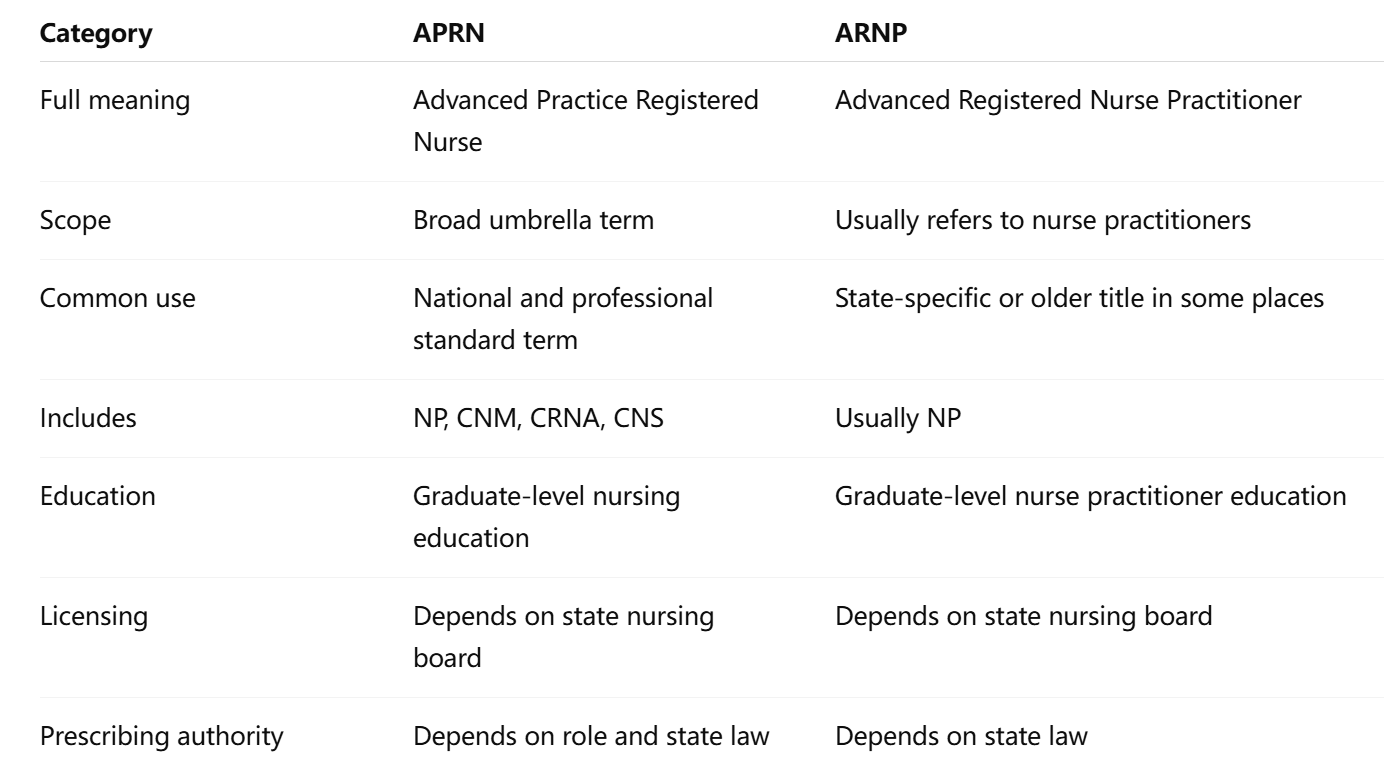
The main difference is that APRN is the broader and more standard term, while ARNP is usually a more specific or state-based term for nurse practitioners.
In simple terms:
APRN is an umbrella category for advanced practice nurses.
ARNP often refers to an advanced registered nurse practitioner, which is usually a type of APRN.
So, an ARNP may be an APRN, but not every APRN is called an ARNP.
For example, a nurse anesthetist and a nurse-midwife are APRNs. But they would not usually be called ARNPs if ARNP is being used to mean nurse practitioner.
APRN vs. ARNP Comparison
Is ARNP the Same as APRN?
Sometimes yes, but not always.
In everyday conversation, some people may use APRN and ARNP almost the same way, especially when talking about nurse practitioners. But technically, APRN is broader.
For example:
A family nurse practitioner may be called an APRN.
In some states or systems, that same person may also be called an ARNP.
A certified registered nurse anesthetist is an APRN, but not usually an ARNP.
This is why it is important to check the state board of nursing or the job description. Titles may vary by state, employer, and specialty.
Why Are There Different Nursing Titles?
Different nursing titles exist because nursing regulation developed differently across states.
Over time, many organizations moved toward the term APRN to make advanced nursing titles more consistent. The APRN Consensus Model was created to improve clarity and consistency in APRN regulation, including licensure, accreditation, certification, and education.
Even so, older terms and state-specific terms still appear in job listings, licenses, healthcare systems, and patient-facing materials.
That is why you may still see titles like:
APRN
ARNP
NP
CNP
APN
CRNP
Many of these titles refer to advanced nursing roles, but the exact legal meaning can vary by state.
Common APRN Roles
Because APRN is a broad category, it is helpful to understand the main roles included under it.
1. Nurse Practitioner, or NP
A nurse practitioner provides primary, acute, or specialty care. NPs may diagnose conditions, order and interpret tests, prescribe medications, and manage treatment plans, depending on state law and specialty area. The American Association of Nurse Practitioners says NPs provide a range of primary, acute, and specialty healthcare services.
Common NP specialties include:
Family Nurse Practitioner
Adult-Gerontology Nurse Practitioner
Pediatric Nurse Practitioner
Psychiatric-Mental Health Nurse Practitioner
Women’s Health Nurse Practitioner
Emergency Nurse Practitioner
2. Certified Nurse-Midwife, or CNM
A certified nurse-midwife focuses on reproductive health, pregnancy, childbirth, postpartum care, and newborn care.
CNMs may work in hospitals, clinics, birth centers, and community health settings. They are APRNs, but they are not usually called ARNPs.
3. Certified Registered Nurse Anesthetist, or CRNA
A certified registered nurse anesthetist provides anesthesia care before, during, and after medical procedures.
CRNAs often work in hospitals, surgical centers, pain management clinics, and emergency care settings. They are also APRNs.
4. Clinical Nurse Specialist, or CNS
A clinical nurse specialist provides advanced clinical expertise in a specific area of nursing. CNSs may work in patient care, staff education, quality improvement, research, and healthcare system improvement.
They are APRNs, but their role is different from a nurse practitioner.
Education Requirements for APRN and ARNP Roles
Education requirements vary by role and state, but advanced practice nurses usually need:
A registered nurse license
A graduate nursing degree
Advanced clinical training
National certification in a role or specialty
State licensure or recognition as an advanced practice nurse
The NCSBN describes APRNs as registered nurses educated in a specific role and patient population at the master’s or post-master’s level.
For nurse practitioners, this usually means completing a graduate-level nurse practitioner program and passing a national certification exam in a specialty area.
Some APRN roles may now require or prefer a Doctor of Nursing Practice, or DNP, depending on the role, employer, and professional direction.
Licensing and Scope of Practice
APRN and ARNP practice authority depends heavily on state law.
Some states allow nurse practitioners to practice with full authority. Others require physician collaboration, supervision, or written agreements for certain parts of practice. The National Conference of State Legislatures explains that practice authority refers to whether an NP can practice with or without physician oversight, while prescriptive authority refers to the ability to prescribe medications.
Because rules vary, you should always check the nursing board in the state where you plan to work.
For example, Florida now uses the term Advanced Practice Registered Nurse, or APRN, in its Board of Nursing materials and state statute.
APRN vs. ARNP in Job Searches
If you are searching for jobs, you may want to search multiple titles.
Try search terms like:
APRN jobs
ARNP jobs
Nurse practitioner jobs
NP jobs
Advanced practice nurse jobs
Family nurse practitioner jobs
Clinical nurse specialist jobs
This is useful because employers may use different titles in job posts. One hospital may write APRN, while another may write ARNP or NP for a similar nurse practitioner role.
When reviewing a job post, pay attention to the role, specialty, required license, certification, state rules, and expected duties. The title alone may not tell the full story.
APRN vs. ARNP for Students
If you are a nursing student, the safer term to learn first is APRN because it is the broader professional category.
Then, choose the specific APRN role you want to pursue.
For example, you may decide to become:
A Family Nurse Practitioner
A Psychiatric-Mental Health Nurse Practitioner
A Certified Nurse-Midwife
A Certified Registered Nurse Anesthetist
A Clinical Nurse Specialist
If you want to become an ARNP, you are most likely looking at a nurse practitioner pathway. But you should still check your state’s official title and licensing requirements.
Which Title Should You Use?
Use the title that matches your license, certification, employer policy, and state rules.
In general:
Use APRN when talking about advanced practice nursing as a broad category.
Use NP when talking specifically about nurse practitioners.
Use ARNP only when it is the official or commonly used title in your state or workplace.
If you are writing a resume, LinkedIn profile, or professional bio, use the title shown on your license and certification documents. This helps avoid confusion.
Use Dokie AI to Create Nursing Career Presentations

Healthcare titles like APRN, ARNP, NP, CNM, CRNA, and CNS can be confusing, especially for students preparing class projects, nursing career reports, or healthcare training materials.
Dokie AI can help turn complex information into a clear presentation. You can use it to create nursing career path slides, healthcare role comparisons, classroom presentations, or professional training decks. Instead of starting from a blank slide, Dokie AI helps organize your ideas into a structured and easy-to-present format.
This is useful for students, teachers, healthcare trainers, and professionals who need to explain medical or career topics clearly.
Common Mistakes to Avoid
One common mistake is assuming APRN and ARNP always mean exactly the same thing. They may be used similarly in some contexts, but APRN is broader.
Another mistake is ignoring state rules. Nursing titles, scope of practice, and prescribing authority can vary by state.
A third mistake is using ARNP when referring to all advanced practice nursing roles. Nurse-midwives, nurse anesthetists, and clinical nurse specialists are APRNs, but they are not usually called ARNPs.
A final mistake is relying only on job titles. Always read the job description, licensing requirements, and certification requirements carefully.
FAQs About APRN vs. ARNP
1. What is the difference between APRN and ARNP?
APRN means Advanced Practice Registered Nurse. It is a broad term for advanced nursing roles. ARNP usually means Advanced Registered Nurse Practitioner and often refers specifically to nurse practitioners.
2. Is an ARNP a nurse practitioner?
In many cases, yes. ARNP commonly refers to an Advanced Registered Nurse Practitioner. However, the exact title can depend on the state.
3. Is every APRN an ARNP?
No. APRN includes nurse practitioners, nurse-midwives, nurse anesthetists, and clinical nurse specialists. ARNP usually refers to nurse practitioners, so not every APRN is an ARNP.
4. Which title is more common, APRN or ARNP?
APRN is the broader and more widely used professional term. ARNP may still appear in some states, job posts, or healthcare systems.
5. Can APRNs prescribe medication?
Many APRNs can prescribe medication, but prescriptive authority depends on the APRN role and state law. Some states allow more independent prescribing, while others require physician involvement.
6. Should I search for APRN or ARNP jobs?
Search both if you are looking for nurse practitioner jobs. Also search NP, nurse practitioner, and your specialty title, such as family nurse practitioner or psychiatric nurse practitioner.
Conclusion
APRN and ARNP are closely related terms, but they are not always the same.
APRN is the broader term for advanced practice registered nurses, including nurse practitioners, nurse-midwives, nurse anesthetists, and clinical nurse specialists. ARNP usually refers to an advanced registered nurse practitioner and is often used as a state-specific or older title for nurse practitioners.
If you are planning a nursing career, applying for jobs, or writing a professional profile, always check your state nursing board and use the title that matches your license and certification.