Critical Symbolism in “Harrison Bergeron”: What Vonnegut’s Images Really Mean
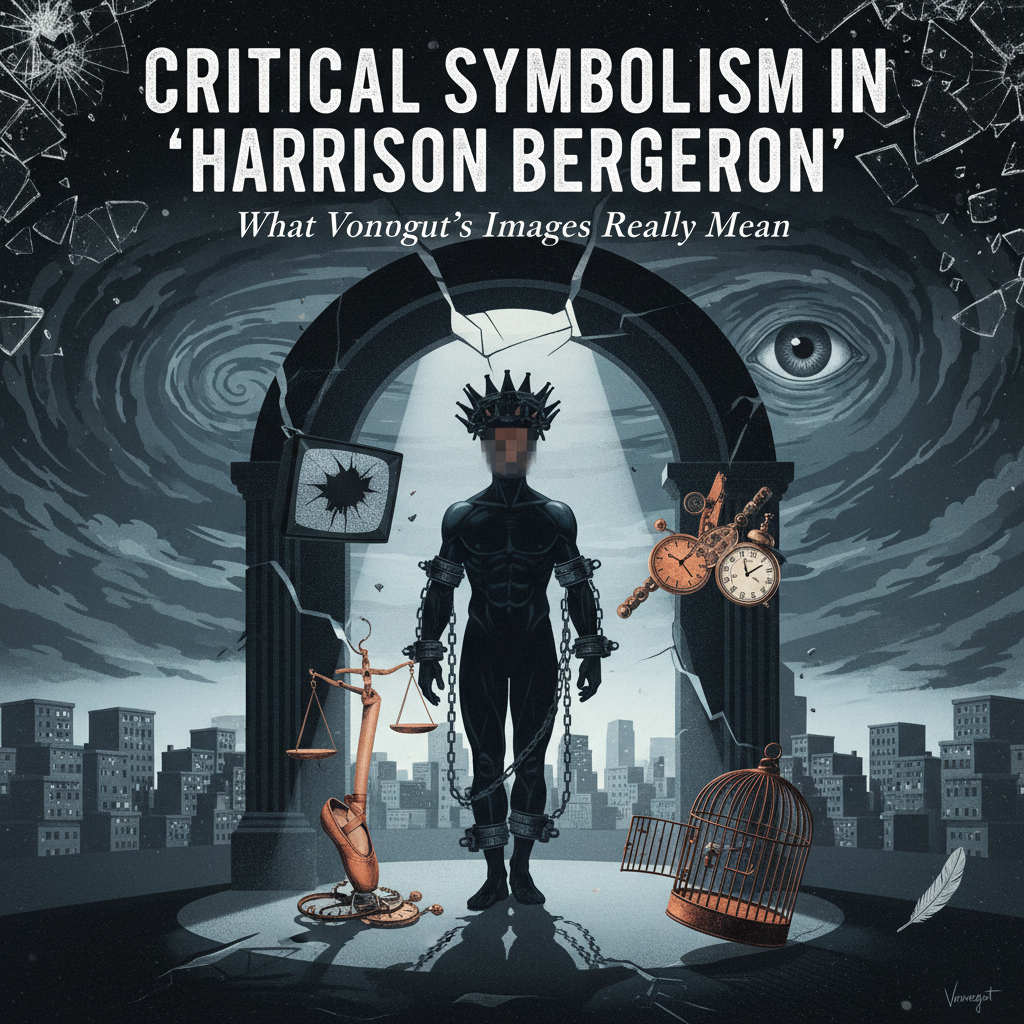
Kurt Vonnegut’s “Harrison Bergeron” remains one of the most discussed dystopian short stories in American literature, largely because of its sharp use of symbolism. On the surface, the story presents a society obsessed with equality. Beneath that surface, however, Vonnegut builds a layered critique of power, conformity, and the dangerous misuse of political ideals. A critical analysis of symbolism in “Harrison Bergeron” reveals that nearly every major object, character, and setting detail carries deeper meaning.
Rather than using symbolism as decoration, Vonnegut turns it into the story’s central engine. The handicaps, the ballerinas, the television broadcast, and Harrison himself all function as symbols that expose the tension between individuality and enforced sameness. By reading these elements closely, we can better understand how the story warns against systems that confuse fairness with uniformity.
Why Symbolism Matters in “Harrison Bergeron”
Vonnegut wrote the story in a plain, almost detached style, but that simplicity is deceptive. The story’s world is exaggerated in order to make its symbolic meaning unmistakable. The government does not simply regulate behavior; it physically and mentally restrains citizens so no one can outperform anyone else. This extreme setup turns abstract ideas into vivid images.
The symbolism matters because it allows Vonnegut to criticize more than one target at once. He is not merely attacking equality as a principle. Instead, he is questioning what happens when institutions pursue equality in a rigid, mechanical way that strips people of talent, beauty, memory, and freedom. The symbols in the story make this critique emotionally powerful.
The Handicaps as Symbols of Enforced Sameness
The most obvious symbol in the story is the set of handicaps imposed by the government. These devices are designed to neutralize natural advantages: beauty is hidden, strength is weighed down, and intelligence is interrupted by painful sounds. On a literal level, the handicaps maintain state control. Symbolically, they represent a society that fears excellence.
Each handicap dramatizes the idea that difference has become unacceptable. Instead of helping the weak rise, the system forces the gifted to fall. This reversal is central to Vonnegut’s satire. The handicaps symbolize a corrupted version of social justice, one that does not create opportunity but destroys distinction.
- Mental handicaps symbolize attacks on independent thought.
- Physical weights symbolize the punishment of strength and ability.
- Masks and disfigurements symbolize the suppression of beauty and identity.
In this sense, the handicaps are not just tools of regulation. They become symbols of cultural anxiety, political overreach, and the human tendency to resent those who stand out.
George Bergeron’s Earpiece and the Destruction of Thought
George’s mental handicap radio is one of the story’s most chilling symbols. Every time he begins to think deeply, a loud noise interrupts him. Symbolically, this device represents the deliberate destruction of concentration, reflection, and critical thinking. Vonnegut suggests that authoritarian systems do not only police actions; they disrupt the mind itself.
The earpiece also reflects the modern fear of constant distraction. George cannot sustain a meaningful idea because his thinking is repeatedly shattered. As a symbol, the radio speaks to more than government censorship. It also points to a culture in which noise, speed, and interruption prevent people from engaging with serious questions.
This matters because clear thought is necessary for resistance. If citizens cannot think, compare, remember, or question, they become easy to govern. George’s earpiece symbolizes a society where intelligence survives only in fragments.
Hazel Bergeron as a Symbol of Passive Acceptance
Hazel is often read simply as an average person, but symbolically she represents something more troubling: passive acceptance. She does not challenge the system, even when it harms her family. Her short memory and emotional softness make her sympathetic, yet they also show how easily ordinary people can adapt to oppressive conditions.
Hazel symbolizes the public’s vulnerability to simplified ideas. She accepts authority because she has been conditioned not to examine it. Her character suggests that tyranny does not depend only on cruel rulers. It also depends on citizens who have lost the habit of judgment.
Vonnegut does not portray her as evil. That is exactly the point. Oppressive systems often endure not because everyone supports them enthusiastically, but because many people are too distracted, tired, or unprepared to oppose them.
Harrison Bergeron as a Symbol of Radical Individuality
Harrison himself is the story’s largest and most dramatic symbol. At fourteen, he is described as exceptionally strong, intelligent, and charismatic. The state labels him dangerous because he possesses qualities that cannot be easily controlled. Symbolically, Harrison represents unrestrained individuality, human potential, and the rebellious spirit.
His exaggerated traits are important. Vonnegut turns him into a near-mythic figure to show how threatening excellence appears in a society built on forced mediocrity. When Harrison breaks free of his handicaps, the act symbolizes more than personal rebellion. It becomes a brief restoration of human possibility.
At the same time, Harrison is not presented as a perfectly stable hero. His rebellion is theatrical and impulsive. This complexity matters in a critical analysis because it prevents a simplistic reading. Harrison symbolizes liberation, but he also suggests that resistance in a deeply controlled society may emerge in unstable, spectacular forms rather than organized political change.
The Ballerinas and the Distortion of Beauty
The ballerinas in the television studio are powerful symbols of damaged art. Ballet traditionally represents grace, discipline, and the celebration of refined physical ability. In Vonnegut’s world, however, the dancers are burdened with weights and forced to hide their faces. Their performance becomes a parody of beauty.
This symbolism points to the cost of suppressing excellence in the arts. When beauty must be concealed to avoid offending others, culture itself is diminished. The ballerinas symbolize what happens when a society becomes suspicious of admiration and achievement.
They also reflect the broader dehumanization at work in the story. Art depends on expression, and expression depends on difference. By handicapping the dancers, the state turns living artists into controlled bodies. Vonnegut’s warning is clear: when conformity becomes the highest value, art loses its power to elevate human life.
The Television Broadcast as a Symbol of State Power
The television in the Bergeron home is more than a household object. It symbolizes the role of mass media in shaping perception and reinforcing power. Harrison’s rebellion does not occur in private; it unfolds on screen, where the state also stages its response. This setting suggests that political authority operates through spectacle as much as through force.
Television compresses reality into images that can be managed, interrupted, or replaced. The public witnesses a shocking event, but the emotional effect fades quickly. Hazel begins to cry and then forgets why. This detail turns television into a symbol of fleeting awareness. Even dramatic truths may disappear in a culture of passive viewing.
Vonnegut anticipates a world in which media can numb as easily as it can reveal. The broadcast promises access to reality, yet it also distances viewers from action and memory.
The Dance Scene as a Symbol of Temporary Freedom
One of the most memorable moments in the story is the dance between Harrison and the ballerina he chooses as his empress. After removing their handicaps, they leap upward in an almost supernatural display of beauty and power. Symbolically, this scene represents a vision of liberated humanity.
The dance is important because it contrasts sharply with the dullness of the surrounding world. For a brief moment, the body is no longer restrained, art is no longer degraded, and love becomes an act of defiance. Their ascent suggests transcendence, the possibility that human beings are meant for more than managed equality.
Yet the moment is also fragile. Its beauty exists only for seconds before violence destroys it. This brevity is part of the symbolism. Freedom, in the story, is not secure. It appears as a flash of truth within a system designed to erase it.
Diana Moon Glampers as a Symbol of Authoritarian Equality
The Handicapper General, Diana Moon Glampers, symbolizes the state’s monopoly on defining justice. Her role is not to protect rights but to enforce sameness. The title itself is significant: she is not simply a political leader but the official manager of limitation.
When she shoots Harrison and the ballerina, the act symbolizes the speed with which authoritarian systems crush visible resistance. There is no debate, no trial, and no hesitation. The violence is immediate because the regime cannot allow alternative models of human excellence to survive in public view.
Glampers embodies the story’s central fear: that noble language about equality can be used to justify domination. Through her, Vonnegut shows how easily moral ideals can become instruments of control when concentrated in unchecked authority.
The Story’s Deeper Warning About Equality and Freedom
A strong critical analysis of symbolism in “Harrison Bergeron” must avoid an overly narrow interpretation. Vonnegut is not arguing against compassion or equal dignity. Instead, his symbols warn against a system that mistakes equality of worth for equality of outcome in every visible form. When governments or cultures try to erase all differences, they do not create justice. They create fear, blandness, and repression.
The story’s symbols work together to deliver this warning:
- The handicaps show the punishment of talent.
- The earpiece shows the disruption of thought.
- The ballerinas show the corruption of art and beauty.
- Harrison shows the danger and necessity of individual defiance.
- The television shows how quickly truth can become spectacle.
These symbols remain relevant because the pressures they describe have not disappeared. Modern societies still struggle with balancing fairness, excellence, freedom, and inclusion. Vonnegut’s story endures because it dramatizes what can go wrong when one value is pursued without wisdom or limits.
Conclusion
The symbolism in “Harrison Bergeron” transforms a short dystopian narrative into a lasting political and cultural critique. Vonnegut uses vivid symbols to reveal the cost of enforced sameness: damaged thought, weakened art, passive citizens, and a government empowered to suppress human potential. Harrison’s brief uprising does not solve these problems, but it exposes them.
Ultimately, the story asks a difficult question: what kind of equality truly honors human beings? Through symbolism, Vonnegut argues that a just society should protect dignity without punishing difference. That tension is what makes “Harrison Bergeron” still feel urgent, provocative, and worthy of close reading today.