Critical Analysis of Waiting for Godot: Themes, Symbols, and Meaning
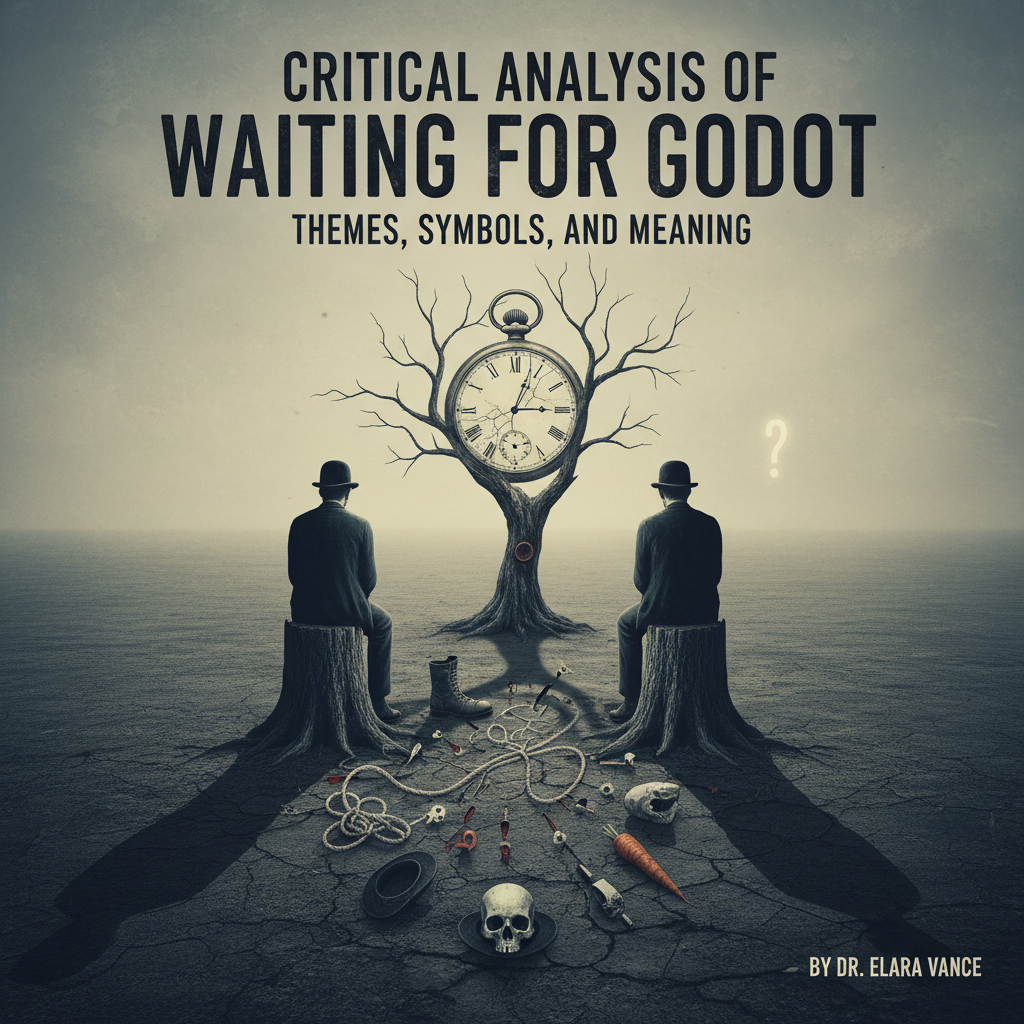
Samuel Beckett’s Waiting for Godot remains one of the most discussed plays in modern literature because it challenges nearly every expectation audiences bring to drama. There is no conventional plot, no satisfying resolution, and no clear explanation of the mysterious Godot. Yet this apparent simplicity conceals a deeply layered work that explores time, identity, suffering, hope, and the human need for meaning. A critical analysis of Waiting for Godot reveals why the play continues to resonate across generations.
First performed in the 1950s, the play is often associated with the Theatre of the Absurd, a movement that reflected the uncertainty and disillusionment of the postwar era. Beckett strips away familiar dramatic structures and replaces them with repetition, silence, fragmented dialogue, and circular action. Rather than telling a straightforward story, he creates an experience that mirrors the confusion and instability of human existence.
Overview of the Play
The play centers on two tramps, Vladimir and Estragon, who wait beside a barren tree for someone named Godot. They are uncertain about where they are, when Godot will arrive, and even whether they are waiting in the right place. During their waiting, they encounter Pozzo and his servant Lucky, whose strange and shifting relationship adds another layer to the play’s examination of power and dependence. At the end of each act, a boy appears to say that Godot will not come today, but surely tomorrow.
This premise is deceptively simple. The real drama lies not in external action but in the characters’ attempts to endure time, maintain companionship, and protect themselves from despair.
The Meaning of Waiting
Waiting is the central action of the play, but Beckett turns it into something larger than a mere delay. In Waiting for Godot, waiting becomes a metaphor for the human condition. People often live in expectation: expecting success, salvation, certainty, purpose, or some event that will finally make life understandable. Godot represents that deferred meaning.
The painful irony is that waiting gives the characters a reason to continue, even while it traps them in passivity. Vladimir and Estragon do not leave because they believe Godot may come. Their hope sustains them, but it also prevents change. Beckett suggests that hope and paralysis can exist together, making waiting both necessary and destructive.
This tension is part of the play’s lasting power. The audience is led to ask whether waiting is noble, foolish, or simply unavoidable. Beckett refuses to provide an easy answer.
Absurdism and the Collapse of Traditional Meaning
Waiting for Godot is one of the defining works of absurdist drama because it dramatizes a world in which traditional systems of meaning appear unstable. Language breaks down, memory is unreliable, and time seems to loop rather than progress. The usual promise of drama—that events lead to understanding—is deliberately frustrated.
However, the play is not meaningless. Its form embodies its ideas. The repetition of lines, pauses, and actions reflects a world where certainty is elusive. Beckett does not simply say that life is confusing; he makes the audience feel that confusion. This is why the play can seem funny, frustrating, tragic, and philosophical all at once.
Absurdism in Beckett is not chaos for its own sake. It is a precise artistic method for exploring what remains when inherited beliefs no longer offer comfort. In that sense, the play asks a profound question: how do human beings continue when clear purpose is absent?
Vladimir and Estragon as Human Complements
Vladimir and Estragon are among the most memorable pairs in literature because they function as both distinct individuals and complementary halves of a shared existence. Vladimir is often more reflective, concerned with memory, belief, and larger questions. Estragon is more physical, immediate, and focused on bodily discomfort. Together they create a portrait of divided humanity: mind and body, thought and survival, faith and exhaustion.
Their conversations frequently appear comic or trivial, yet beneath the humor lies genuine vulnerability. They quarrel, threaten to separate, and struggle to remember the past, but they remain together because companionship helps them endure the emptiness around them. Their friendship may be imperfect, but it is one of the few defenses they have against isolation.
A critical reading of the play shows that Beckett treats human connection as fragile but essential. Even in a world without clear answers, the presence of another person offers temporary relief from loneliness and fear.
The Enigma of Godot
No analysis of Waiting for Godot can avoid the question: who or what is Godot? Beckett famously resisted fixed interpretations, and that openness is part of the play’s design. Godot has often been read as a symbol of God, salvation, authority, death, meaning, or the future itself. Yet the play never confirms any of these views.
The ambiguity matters. If Godot had a defined identity, the play would become a puzzle with a solution. Instead, Beckett preserves uncertainty, allowing Godot to function as a projection of human expectation. The characters invest him with importance, but they know almost nothing about him. In this way, Godot represents the promises people use to structure their lives, even when those promises remain unfulfilled.
The fact that Godot never arrives is not merely a plot device. It is the play’s most powerful statement about deferred hope and unresolved meaning.
Symbolism in the Play
The Tree
The tree is one of the play’s most striking symbols. In Act I, it appears barren and lifeless; in Act II, it has a few leaves. This slight change has inspired many interpretations. It may suggest renewal, the passage of time, false hope, or the possibility that change occurs so subtly that it cannot transform the characters’ situation in any meaningful way.
Boots and Hats
Estragon’s boots and Vladimir’s hat are recurring objects that seem comic at first, but they also carry symbolic weight. The boots point to physical suffering and material existence, while the hat suggests thought, identity, and mental activity. Beckett uses these simple items to reinforce the contrast between bodily pain and intellectual uncertainty.
Road and Setting
The nearly empty stage emphasizes isolation. The road implies movement and journey, yet the characters remain still. This contradiction captures the essence of the play: the possibility of progress exists, but it is never realized.
Pozzo and Lucky: Power, Dependency, and Decline
The arrival of Pozzo and Lucky introduces a more visibly dramatic relationship. Pozzo appears commanding and theatrical, while Lucky is burdened, silent, and controlled. At first, their roles seem fixed: master and servant, power and submission. But in Act II, Pozzo is blind and Lucky is mute, showing how quickly status and ability can collapse.
This reversal undermines the illusion of stable hierarchy. Beckett suggests that power is temporary, identity is vulnerable, and human beings are all subject to decline. Lucky’s famous speech, chaotic and fragmented, is especially important in critical analysis because it parodies intellectual systems that attempt to explain existence through logic alone. The speech sounds learned, but it fails to provide coherence. Knowledge, like language itself, proves unreliable.
Time, Memory, and Repetition
One of the most unsettling features of the play is its treatment of time. The two acts resemble each other so closely that they almost seem to repeat. The characters cannot clearly remember what happened before, and they are unsure whether events are changing at all. This creates a sense that time is passing and not passing simultaneously.
Beckett uses repetition to expose the instability of human memory and the difficulty of measuring existence. If people cannot trust memory, they cannot build a coherent story about themselves. Without that story, identity becomes fragile. Vladimir and Estragon continue speaking partly to confirm that they exist and that their shared experience is real.
This makes the play deeply modern. It reflects a world in which continuity, certainty, and progress no longer feel guaranteed.
Comedy and Tragedy Together
Although Waiting for Godot is often discussed in philosophical terms, its humor is essential to its impact. Beckett draws from vaudeville, clowning, and physical comedy. The characters bicker, stumble, exchange hats, and engage in routines that can make audiences laugh. Yet the laughter is rarely pure. It is shadowed by hunger, hopelessness, and fear.
This blend of comedy and tragedy is one of Beckett’s greatest achievements. Humor becomes a survival mechanism. The characters joke because the alternative is despair. In this sense, the play captures an uncomfortable truth: comedy does not erase suffering, but it can make suffering bearable for a moment.
Why the Play Still Matters
Waiting for Godot continues to matter because its questions remain urgent. People still search for direction, rely on routines, fear emptiness, and postpone life while waiting for clarity that may never come. The play speaks to political uncertainty, spiritual doubt, emotional dependence, and the loneliness of modern life without becoming tied to a single message.
Its openness is precisely why it endures. Different readers and audiences find different meanings in Godot, in the act of waiting, and in the relationship between the characters. The play does not instruct people what to think; it confronts them with conditions they already recognize.
Conclusion
A critical analysis of Waiting for Godot shows that Beckett’s play is far more than a story about two men passing time. It is a profound meditation on uncertainty, endurance, and the human need to keep going despite the absence of guarantees. Through minimal plot, rich symbolism, and a distinctive absurdist structure, Beckett reveals the tension between hope and futility, companionship and isolation, motion and stillness.
The genius of the play lies in its refusal to resolve these tensions. Godot never comes, but the waiting continues. In that unfinished condition, Beckett captures something essential about human life: the search for meaning may be uncertain, but the act of searching defines us.
- Core theme: waiting as a metaphor for human existence
- Key technique: repetition, silence, and circular structure
- Major symbols: the tree, road, boots, hats, and Godot himself
- Central tension: hope sustains life, yet can also prevent action